- Written by
- The Drawings4Planning technical teamChartered architectural technologists (MCIAT)
- Published
- Updated
- Reading time
- 3 min
- Topic
- Planning permission
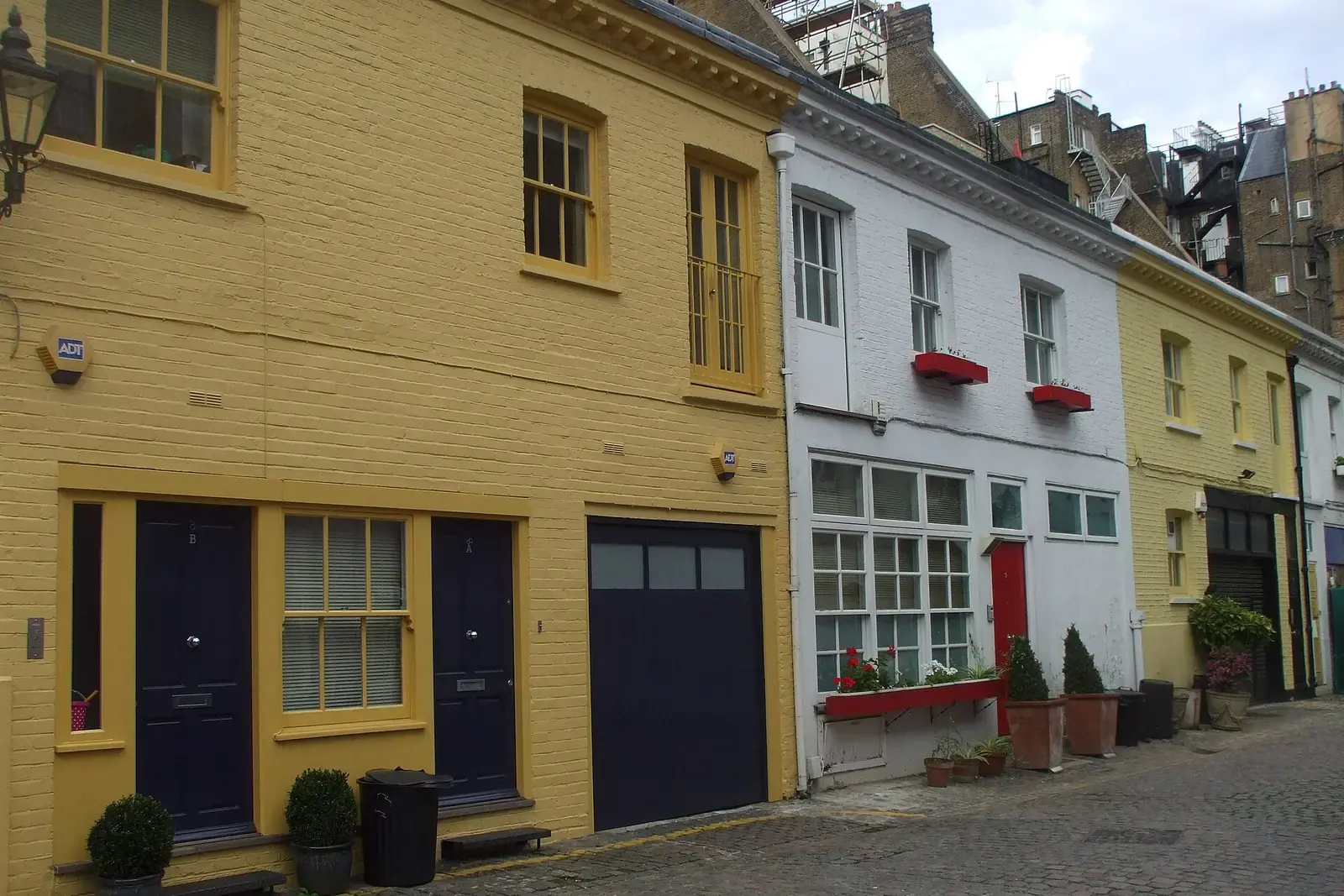
Mews houses painted yellow and white with dark doors, a garage door and red window boxes on a cobbled lane. Photo: John Lord, CC BY-SA 2.0.
What does the £219 get you?
A short document, not a thesis. It sets out the design principles behind the scheme, the site and its surroundings, the approach to access, the policies considered and any consultation. We write it to the length the scheme needs, usually a few pages with a plan and photographs, and it goes in with the application.
The fee is fixed. Where we also prepare your drawings, the statement uses the same survey and model, so the words and the sheets cannot disagree.
| Written statement with plan and photographs paid to us | £219 |
|---|---|
| Total | £219 |
Total £219 to Drawings4Planning. The statement has no council fee of its own.
When is a statement required?
The government’s guidance lists three cases: applications for major development, applications in a designated area for one or more dwellings or a building of 100 m² or more, and applications for listed building consent (gov.uk). A designated area, for this purpose, means a World Heritage Site or a conservation area.
A typical householder extension outside a conservation area is not on that list. A new house in a conservation area is, whatever its size.
When is one not needed?
Applications for waste development, a material change of use, or engineering or mining operations do not need one, and neither do applications to amend the conditions attached to a planning permission (gov.uk). Your council may still ask for design information on its local validation list, so check before you assume.
We read the list for your borough when we quote, and say if a statement is needed or whether your application can go in without one.
What is different for a listed building?
The statement must explain any consultation undertaken and how its outcome shaped the works, and how specific issues affecting access to the building have been addressed (gov.uk). The council also has to have special regard to preserving a listed building or its setting when it decides (s.66).
A listed building usually also needs a heritage statement, which is a separate £539 service. We write the two so they cross-refer without repeating each other.
Where the figures come from
- Major
- A Design and Access Statement is required for applications for major development. gov.uk, Making an application
- 100 m²
- In a designated area it is required for one or more dwellings, or a building of 100 m² or more. gov.uk, Making an application
- Designated area
- For this purpose a designated area means a World Heritage Site or a conservation area. gov.uk, Making an application
- Listed
- It is required for applications for listed building consent. gov.uk, Making an application
- Not needed
- Material changes of use and applications to amend conditions do not need one. gov.uk, Making an application
- s.66
- The council must have special regard to preserving a listed building or its setting. Planning (Listed Buildings and Conservation Areas) Act 1990, s.66(1)
Design and Access Statement cost questions
Is the statement included in your planning drawings fee?
No. Planning drawings are £629 with the survey. Where a statement is needed we quote it as its own £219, so you can see what each part costs.
Can you write one for an application someone else drew?
Yes, that is what the standalone £219 is for. We ask for the drawings and a few site photographs, and write the statement against them.
How long should it be?
As long as the scheme needs, no longer. The guidance asks for it to be proportionate to the complexity of the application, and not to be long.
Source: gov.uk, Making an application
Does the council charge for the statement?
No. The council’s fee is for the application, and the statement goes in with it.
Full details of the service: Design and Access Statements.