- Written by
- The Drawings4Planning technical teamChartered architectural technologists (MCIAT)
- Published
- Updated
- Reading time
- 4 min
- Topic
- Planning permission
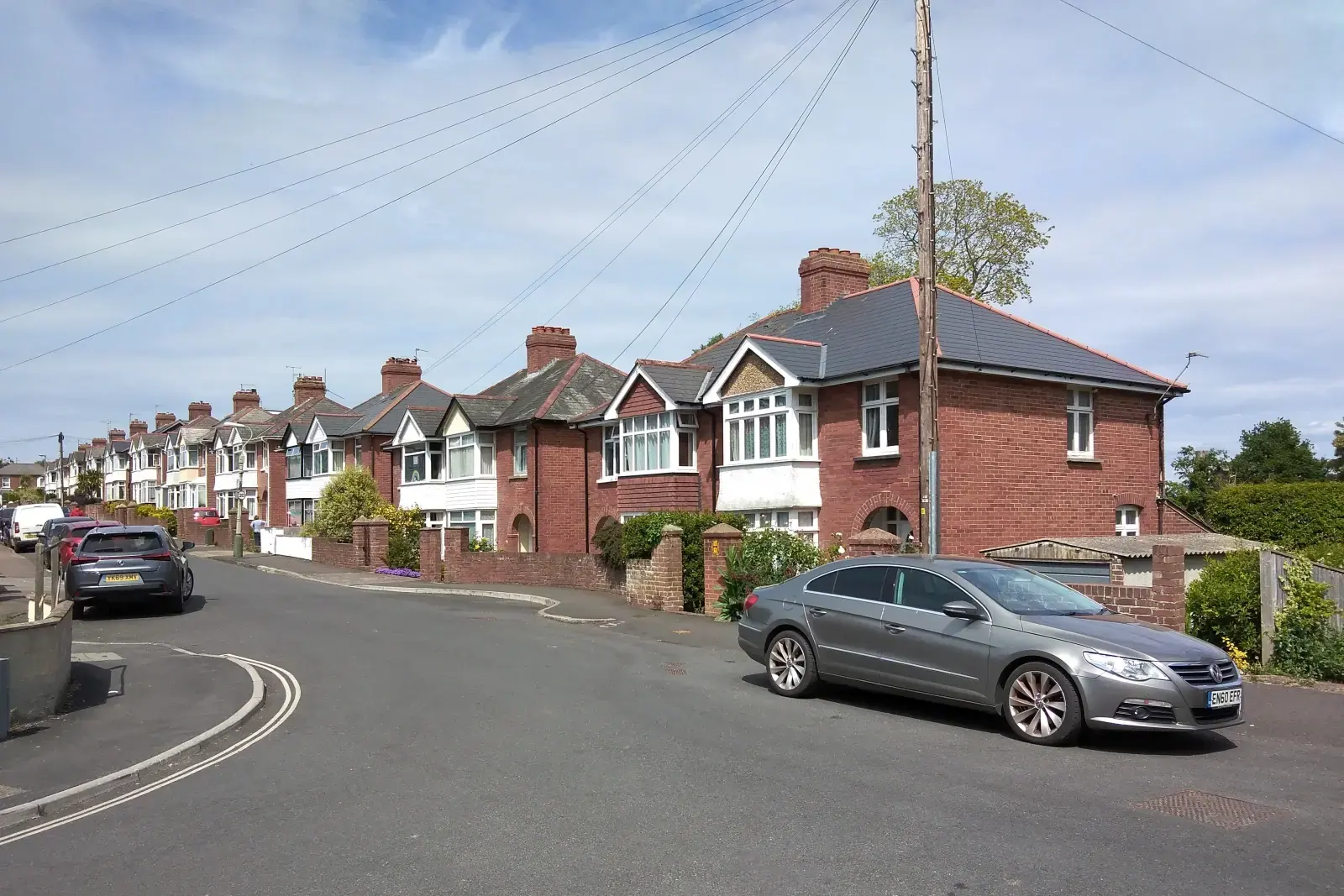
A curving street of 1930s semi-detached houses in red brick and white render in Exeter, a grey car parked in the foreground. Photo: David Smith, CC BY-SA 2.0.
Why does the council charge £274 and not £548?
Because the fee depends on what the certificate is about. For a proposed use or operation the council charges half of the full application fee. A householder application is £548, so the certificate is £274; for work already carried out it is the same as the full fee (fee schedule).
That rule makes the certificate route kinder to the wallet than planning permission whenever the work truly is permitted development, and it is why we test the rules first, before anyone pays a council fee for the wrong paper.
| Permitted development drawings and forms paid to us | £389 |
|---|---|
| Measured survey of the house paid to us | £150 |
| Council certificate fee (half the planning fee) paid to the council | £274 |
| Total | £813 |
Total £813: £539 to Drawings4Planning and £274 to the council.
What are you buying for the money?
A decision, in writing, that the work is lawful. The certificate is made under section 192 of the Town and Country Planning Act 1990 (s.192), and the council gets there by comparing your drawings to the permitted development rules, not by weighing design or neighbours’ views. It is also not a permission: nothing forces you to apply.
The reward for applying is certainty. Once granted, the work must be presumed lawful unless a material change happens before you begin, such as an Article 4 direction that removes the right you relied on (gov.uk guidance). Your neighbours are not automatically consulted either, as there is no statutory requirement to consult them.
When does it stop being the cheaper route?
When the work breaks a permitted development limit. A single-storey rear extension deeper than 3 m (4 m detached) needs the prior approval notice, up to 6 m (8 m detached) (GPDO Class A), and a flat has no such rights at all. An application that cannot succeed wastes the £274 as well as our fee.
That is why the £539 is spent on the check as much as on the drawings. If your idea fails, we tell you before you pay the council and point you to the route that fits: a notice, or a householder application.
What does a certificate not cover?
Building regulations. A certificate speaks about planning only, so your extension still needs its own approval from building control. Our building regulations set is £479 when we have already surveyed the house, so the full journey to a buildable set of drawings costs £1,018 to us (£539 plus £479).
Larger or more mixed projects, such as a rear extension combined with a roof enlargement, are priced as a range from £539 to £849 in total (£389 to £699 in drawings plus the £150 survey). We say which side of the range you are on before you commit.
Where the figures come from
- £274
- Half of the £548 householder fee, the council’s charge for a certificate for proposed work. National fee schedule, published by Bradford Council
- Full fee
- A certificate for an existing use or operation costs the same as a full application. National fee schedule, published by Bradford Council
- s.192
- The section of the 1990 Act that allows a certificate for proposed use or operations. Town and Country Planning Act 1990, s.192
- Presumed lawful
- Work done in line with a certificate is presumed lawful unless a material change happens first. gov.uk, Lawful development certificates
- No consultation
- There is no statutory requirement for the council to consult neighbours on a certificate. gov.uk, Lawful development certificates
- 3 m / 4 m
- Deepest single-storey rear extension without a notice: terraced or semi-detached / detached. GPDO 2015, Sch. 2 Part 1, Class A
Certificate cost questions
Do I have to get a Lawful Development Certificate?
No. It is optional and the planning rules apply with or without it. People apply to hold proof, often because a buyer’s solicitor may ask for it later.
Is the £274 refunded if the council says no?
No. The fee pays for the council’s decision, whichever way it goes. That is why we check the permitted development rules against the survey before the application is sent.
Can I get a certificate for an extension I already built?
Yes, as an existing-use certificate, but the council fee is then the full £548 and the evidence needs to show when the work was done. Our retrospective service covers work that needs permission rather than a certificate.
Does the price change if I am in a conservation area?
The price does not, but the answer can: roof enlargements such as dormers are not permitted development on conservation area land, so a householder application is the route there.
Full details of the service: Lawful Development Certificate.