- Written by
- The Drawings4Planning technical teamChartered architectural technologists (MCIAT)
- Published
- Updated
- Reading time
- 3 min
- Topic
- Planning permission
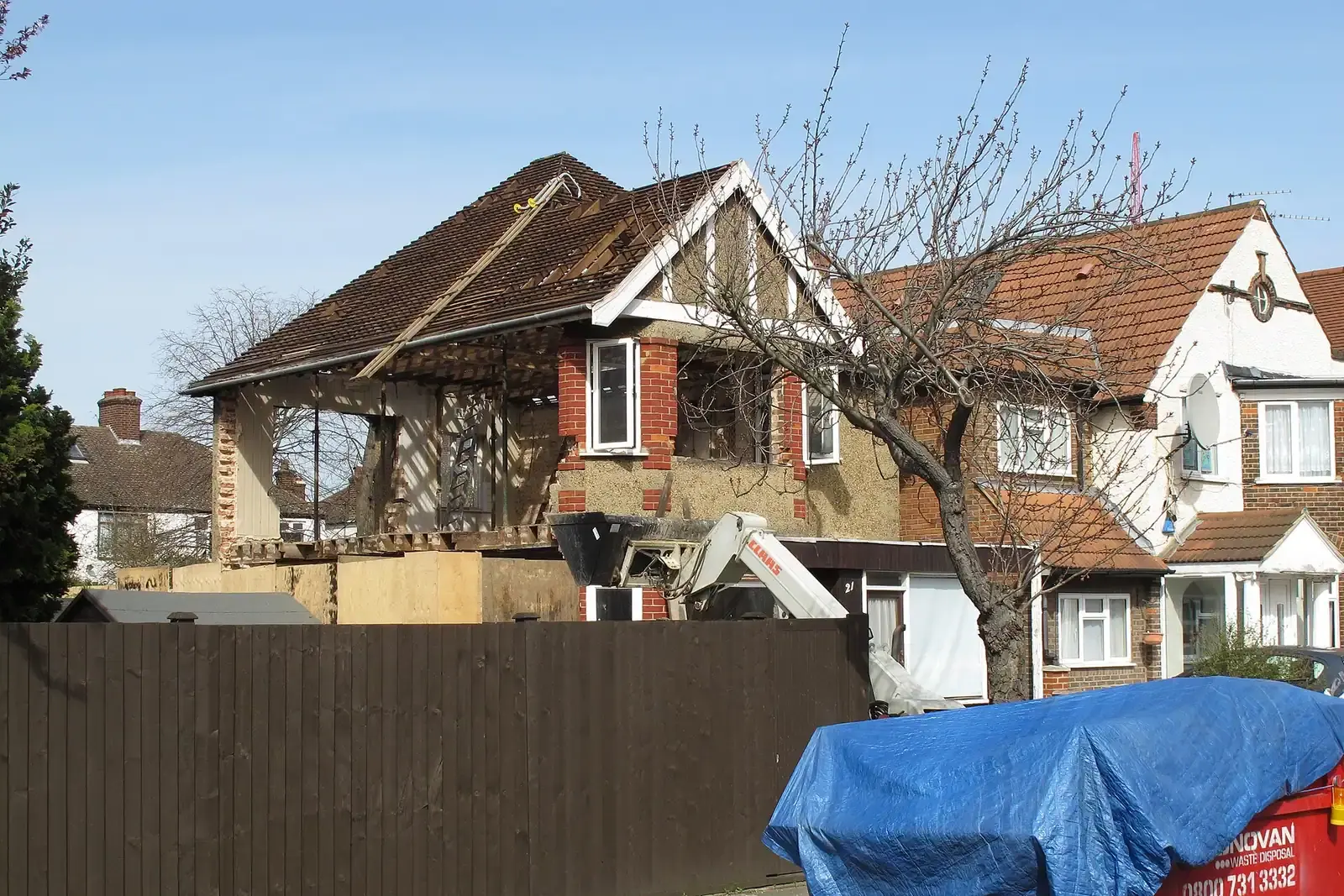
House stripped back for a major extension with its roof timbers exposed, a mini excavator behind the fence and a blue-tarped skip beside it. Photo: David Hawgood, CC BY-SA 2.0.
What do you pay?
Two bills, one to us and one to the council. We charge £439 for the drawings and application, and £150 for a measured survey of the building as it stands, which makes £589. The council charges £548 for a householder application to alter or extend a house (fee schedule); we found no separate line in that schedule for work already built.
Nothing is added for the awkwardness of the job. Retrospective drawings take the same effort as any planning set, apart from one thing: nobody can tidy the building before we measure it, so we draw exactly what is there.
| Drawings of what is built, forms, submission paid to us | £439 |
|---|---|
| Measured survey of the building as it stands paid to us | £150 |
| Council householder application fee paid to the council | £548 |
| Total | £1,137 |
Total £1,137: £589 to Drawings4Planning and £548 to the council (fee from 1 April 2026).
What is a retrospective application, legally?
A planning application for development that has already happened. Section 73A of the Town and Country Planning Act 1990 lets a council grant permission for work carried out without permission, work carried out under a time-limited permission, or work that ignored a condition (s.73A). The permission can be made to take effect from the date the work was done.
It is not a form of amnesty and it is not automatic. The council judges your extension on the same planning grounds as if it had not been built, so the drawings must show it clearly and truthfully. A mismatch between plan and building is the surest way to lose the case.
Why does the council only allow one go?
Because the law gives one. A person who has carried out unauthorised development has only one opportunity to obtain permission after the event, either by a retrospective application or by an appeal (gov.uk guidance). That makes the first application the one to get right, and a careful survey and a reasoned design are cheaper than a second route.
The council has 8 weeks to decide a householder application unless you agree longer (gov.uk). We do not promise a decision date or a result; we send the pack, answer the officer and redraw free if a change is asked for.
Is there a time limit to worry about?
For enforcement, yes, but it is long. Operational development, such as an extension, becomes immune from enforcement 10 years after substantial completion where that happened on or after 25 April 2024, and after 4 years where it was completed before then (gov.uk guidance).
That is not a reason to wait. Until the time passes, a council can act, and unauthorised work tends to surface when a house is sold, long before ten years are up. Putting the application in now is how you turn the risk into a record.
Where the figures come from
- £548
- Council fee to alter or extend a single dwellinghouse, from 1 April 2026. National fee schedule, published by Bradford Council
- s.73A
- The section of the 1990 Act that lets planning permission be sought for development already carried out. Town and Country Planning Act 1990, s.73A
- 3 cases
- Section 73A covers work built without permission, under a time-limited permission, or in breach of a condition. Town and Country Planning Act 1990, s.73A(2)
- One go
- There is one opportunity to obtain permission after the event, by an application or an appeal. gov.uk, Enforcement and post-permission matters
- 10 years
- Enforcement limit for operational development substantially completed on or after 25 April 2024. gov.uk, Enforcement and post-permission matters
- 4 years
- Enforcement limit for operational development completed before 25 April 2024. gov.uk, Enforcement and post-permission matters
- 8 weeks
- Statutory decision period for a householder application, unless a longer time is agreed. gov.uk, Determining a planning application
Retrospective application cost questions
Will the council refuse because I built first?
The council weighs the application on its planning merits, as it would for any householder case. The first thing it checks is that the drawings match what stands.
Do I have to pay the council fee again if I change the scheme?
A new application has its own fee. That is one reason we agree the drawings with you against the survey before anything is submitted.
Is a Lawful Development Certificate a cheaper way to regularise it?
Only where the work was permitted development. Then a certificate for work already built carries the full £548 council fee, so it is not cheaper than the application. Our drawings tell you which fits.
Do building regulations still apply to work already done?
Yes. Planning permission does not replace building control, and work done without approval can be regularised separately, which is a different service.
Full details of the service: Retrospective planning drawings.