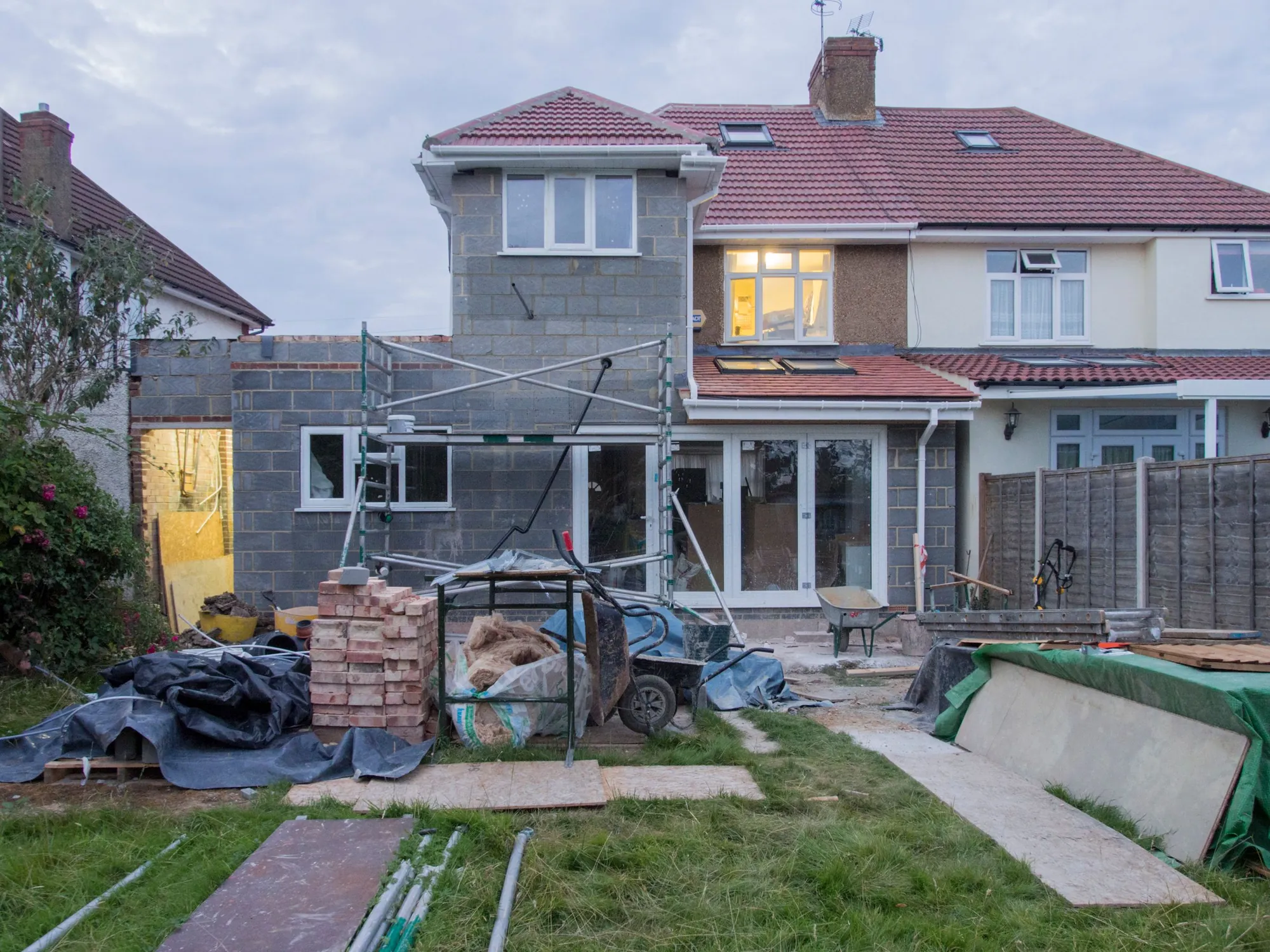
Rear extension drawings in Brent from £589
Brent’s conservation area controls mostly guard the front of the house, so the back is often freer than people expect. In Queen’s Park, Mapesbury or Kensal Green, though, the rules still bite on height.
- £439 drawings + £150 survey (£589 total)
- Brent validation list followed
- Free redraws until approval
What does a Brent rear extension cost to draw?
£589 in total with us: £439 for the drawings, forms and submission and £150 for the measured survey, no VAT to add. Brent Council’s planning fee is paid to the council separately.
What you get in Brent
- Survey photographs of the site and its context, which Brent asks of every application
- Existing and proposed plans and elevations, and a block plan
- A heritage statement where the house is in one of Brent’s 22 conservation areas
- A written justification for any list item that does not apply, so the council does not invalidate the case
- Submission and replies to the Brent case officer
| Our drawings and submission paid to us | £439 |
|---|---|
| Measured survey paid to us | £150 |
| Council householder fee paid to the council | £548 |
| Total | £1,137 |
We charge £589 in total. The £548 is paid to the council when the application goes in, and the survey is charged once if you later order building regulations drawings for the same house.
Brent’s list and the justification rule
Brent’s householder list says that if you leave out a required item you must explain in writing why it is not needed, and the council will make the application invalid if it disagrees (Brent householder list). Photographs of the site and its context are required for all applications, and a heritage statement for any householder application in a conservation area or covered by an Article 4 direction.
A flood risk assessment is needed in Flood Zones 2 and 3 or in critical drainage areas, and a basement impact assessment for any basement. The CIL additional information form is required where 100 m² or more of new floor space is created, which an ordinary rear extension does not reach.
Conservation areas and the front-only Article 4 rule
There are 22 conservation areas in Brent (Brent conservation areas). A 2020 Cabinet report on new directions for the residential ones, such as Mapesbury, Queen’s Park, Brondesbury and Roe Green Village, says Brent’s Article 4 directions generally apply only to front elevations and front gardens (Brent Cabinet report).
That leaves the back largely to the national rules, but those still matter: in a conservation area, a rear extension of more than one storey is outside Class A. For example, a single-storey kitchen extension in Queen’s Park may be permitted development, while adding a first-floor room above it is an application with a heritage statement.
Decisions and CIL in Brent
The statutory period for a householder decision is 8 weeks. Brent decided 643 of 660 householder applications inside it in the year to June 2026.
Brent’s residential CIL is £357.14 per square metre for 2026 permissions, indexed from a £200 base set in 2013 (Brent CIL). A rear extension under 100 m² is exempt under regulation 42.
Brent extensions by the numbers
- 643 of 660
- Brent Council householder applications decided within 8 weeks in the year to June 2026, out of all it decided (prior approvals not counted). MHCLG live table PS2, planning application statistics by district, July 2025 to June 2026 (GOV.UK)
- 22
- Conservation areas in Brent. Listed buildings and conservation areas (Brent Council)
- Front only
- Brent’s Article 4 directions in residential conservation areas generally apply only to front elevations and front gardens. Cabinet report, 7 September 2020: Article 4 directions in residential conservation areas (Brent Council)
- 7 Sep 2020
- Date of the Cabinet report setting out new Article 4 directions for Brent’s residential conservation areas. Cabinet report, 7 September 2020: Article 4 directions in residential conservation areas (Brent Council)
- All applications
- Brent requires photographs of the site and context with every householder application. Applications for householder planning permission: validation list (Brent Council)
- 100 m²
- New floor space at which Brent’s list asks for the CIL additional information form. Applications for householder planning permission: validation list (Brent Council)
- £357.14 per m²
- Brent residential CIL for permissions granted in 2026. Community Infrastructure Levy and Section 106 (Brent Council)
- £72.73 per m²
- The Mayor of London’s CIL in Brent (band 2) for permissions granted in 2026, owed only when a scheme is liable for CIL in the first place. Mayoral CIL: annual rate summary for 2026, Table 1 (Greater London Authority)
- Exempt
- An extension adding less than 100 m² is minor development and pays no CIL. Community Infrastructure Levy Regulations 2010, regulation 42 (legislation.gov.uk)
Brent rear extension questions
Do Brent’s Article 4 directions stop rear extensions?
Generally not: they mostly cover front elevations and front gardens. The conservation area itself still rules out a rear extension of more than one storey without an application.
Do I need a heritage statement in Brent?
Brent asks for one with householder applications in conservation areas or covered by an Article 4 direction. We write it with the drawings.
What if a listed document does not apply to my house?
Brent wants a written reason, and can invalidate the application if it disagrees. We include that note in the pack.
How long does Brent take?
The statutory period is 8 weeks once valid. Brent met it for almost all householder cases in the year to June 2026, but we cannot promise a date.
Other services people book with this one
- Prior approval for a larger home extension£349 drawings + £150 survey (£499 total)
- Lawful Development Certificate drawings£389 drawings + £150 survey (£539 total)
- Building regulations drawings£479 drawings + £150 survey (£629 total)
- Side return extension drawings£479 drawings + £150 survey (£629 total)
- Party wall notice£39
Start your Brent extension
Send the address and the extension you have in mind. We check the conservation area and reply with a fixed fee.